Sunshade Installation Materials: Best Choices (2026)
A good windshield sunshade does more than keep your steering wheel from scorching your hands. It helps protect your dashboard from fading and cracking, reduces cabin temperatures so your A/C works less, and can even help preserve electronics and interior trim over the long run. If you?ve ever climbed into a car that?s been baking in the sun and felt the seatbelt buckle brand your palm, you already understand the value.
What most drivers don?t realize is that sunshades aren?t all built the same?and the material choice affects everything: how well it blocks heat and UV, how easy it is to install, how it folds, and how long it survives daily use. This guide breaks down the common sunshade materials, what they?re best at, and how to choose and install the right style for your vehicle.
Along the way you?ll get real-world tips, a few dependable product-style recommendations (by material type and use case), and a checklist of common installation mistakes that make even a great sunshade feel annoying.
Why Sunshade Material Matters (More Than You Think)
When you shop for a car sunshade, it?s tempting to focus on size and price. Material is the hidden factor that influences performance and day-to-day convenience. Here?s what material impacts most:
- Heat rejection: Reflective layers and insulation reduce heat transfer into the cabin.
- UV protection: Better UV blocking helps slow dashboard fading, leather drying, and plastic brittleness.
- Fit and coverage: Stiffer materials hold shape; flexible ones conform to curves but can sag.
- Ease of installation: Some designs wedge under visors; others suction to glass or snap into place.
- Durability: Repeated folding, high heat, and adhesive fatigue can destroy certain builds quickly.
- Storage: Twist-fold shades store small; rigid panels store flat and need space.
If you park outside daily?especially in hot or high-UV climates?material quality is the difference between a sunshade you use every time and one that ends up crumpled in the trunk.
Common Sunshade Materials and How They Compare
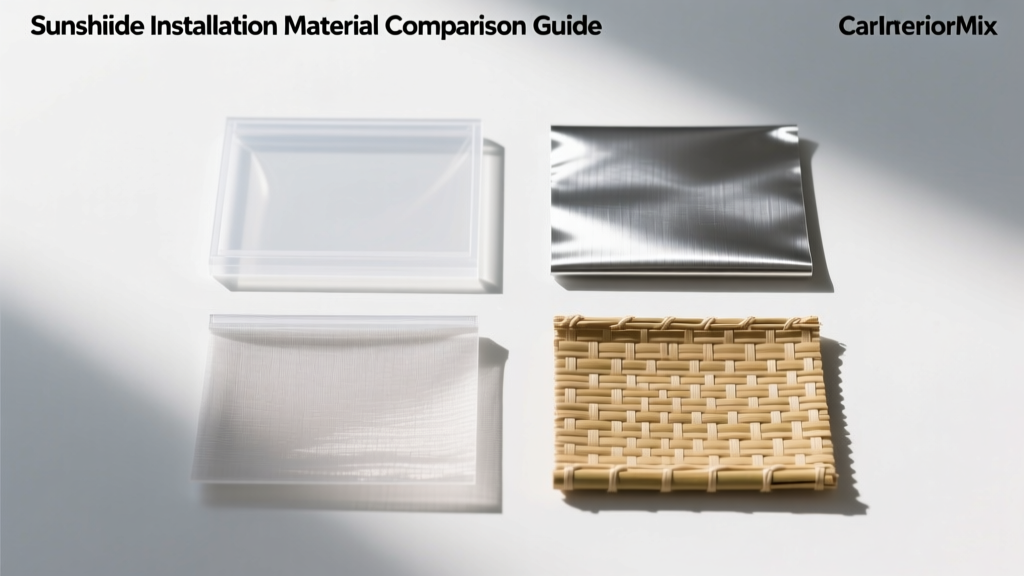
Most windshield sunshades combine two or more layers. You?ll typically see a reflective face (often aluminum-based) plus a core (foam, bubble insulation, fabric) and sometimes a stiffener (spring steel, rods, cardboard-like boards).
1) Reflective Foil + Bubble Insulation (Classic Accordion/Foldable)
What it is: A shiny aluminum foil layer bonded to bubble insulation (similar to reflective insulation used in homes). Often folds accordion-style.
Pros:
- Very good heat reflection for the price
- Lightweight and easy to handle
- Common sizes are widely available
Cons:
- Creases can weaken over time with daily folding
- Edges may curl, reducing coverage near pillars
- Cheaper versions delaminate in extreme heat
Best for: Daily drivers wanting solid performance on a budget.
Real-world tip: If your shade ?droops? in the center, it?s usually because the bubble core is too thin or the fold lines are worn. A slightly thicker, double-layer bubble core holds shape longer.
2) Reflective Foil + Foam Core (Stiffer, Better Insulation)
What it is: A reflective exterior with a foam layer that adds insulation and structure.
Pros:
- Better insulation than bubble-only styles
- Holds its shape better; less sagging
- Often feels more ?premium? and durable
Cons:
- Bulkier to store
- Can crease if folded improperly
- Some foams can warp if stored pressed against hot surfaces
Best for: Hot climates, larger windshields, drivers who care about long-term dashboard protection.
Practical example: If you drive a full-size SUV with a tall windshield, foam-core shades tend to stay planted under the visors better than thin accordion shades.
3) Polyester Fabric + Reflective Coating (Roll-Up or Fold)
What it is: A fabric sunshade (polyester or similar) with a reflective coating on one side.
Pros:
- Flexible?conforms to curved glass
- Often lighter and easier to roll up
- Less ?crinkly? and sometimes looks cleaner
Cons:
- Coatings can scratch or lose reflectivity over time
- May not insulate as well as foil + foam/bubble
- Can sag if not tensioned properly
Best for: Drivers who prioritize easy storage and quick setup over maximum insulation.
4) Pop-Up Twist-Fold Sunshades (Spring Steel Frame)
What it is: A fabric shade stretched over a spring steel perimeter, similar to a pop-up tent. It opens quickly and twist-folds into a small circle.
Pros:
- Fast setup and takedown once you learn the fold
- Stores compactly
- Good coverage when sized correctly
Cons:
- Can be awkward until you master the twist-fold motion
- Edges can interfere with dashboard sensors or mirror mounts if oversized
- Frame can deform if shoved into a tight door pocket
Best for: Commuters who use a shade multiple times a day and want compact storage.
5) Custom-Fit Multi-Layer Shades (Often Foil + Foam + Fabric Binding)
What it is: Vehicle-specific sunshades cut to match the windshield shape, mirror area, and sensor zones. Usually multi-layer with stitched edges.
Pros:
- Best fit and coverage?fewer gaps at corners
- Often better insulation and UV protection
- More stable: less reliance on visors to hold it in place
Cons:
- Costs more than universal shades
- Takes longer to find the exact match for your trim and model year
- May be bulkier (depending on design)
Best for: Enthusiasts, new-car owners, anyone protecting a premium interior (leather dash, Alcantara trim, large infotainment).
Material Comparison: Quick Decision Matrix
If you want a simple way to choose, match your priorities to the material type below:
- Maximum heat reduction: Custom-fit multi-layer, or foil + foam core
- Best value: Foil + bubble insulation accordion shade
- Fastest daily use: Pop-up twist-fold with spring steel frame
- Smallest storage footprint: Pop-up twist-fold, or roll-up fabric style
- Best for large windshields: Foam-core or custom-fit (better structure)
How to Choose the Right Sunshade for Your Car
Step 1: Measure Your Windshield (Don?t Guess)
Even ?universal? shades vary a lot. A close match improves coverage and keeps the shade from popping loose.
- Measure width: From left to right at the widest point of the windshield.
- Measure height: From the dashboard line up to the headliner area (center is usually tallest).
- Note cutouts: Rearview mirror mount, ADAS cameras, toll tags, dash cams.
Tip: If you?re between sizes, choose the one that fits your windshield width best. A shade that?s too tall often buckles and leaves gaps; a shade that?s slightly short in height can still block most direct sun.
Step 2: Consider Your Parking and Climate
- Hot sun, outdoor parking: Prioritize insulation (foil + foam, or custom multi-layer).
- Short stops (errands): Prioritize convenience (pop-up twist-fold).
- Windy areas / doors opening often: Choose a stiffer shade that wedges securely.
- High theft-risk areas: A custom-fit shade can signal ?owner cares,? which some people prefer to avoid. In that case, choose a basic-looking but effective foil/bubble.
Step 3: Check Interior Compatibility
Some dashboards have delicate coatings that can scuff if a rough edge rubs daily. Look for:
- Soft fabric binding around edges
- Smooth seams (not sharp heat-sealed edges)
- No exposed metal frame ends (on pop-up designs)
Step-by-Step: Installing a Windshield Sunshade Correctly
Most ?sunshade doesn?t work? complaints come down to fit or installation. Use this method for a snug, repeatable setup.
For Accordion/Foldable Foil + Bubble or Foil + Foam Shades
- Cool-down check: If the shade is stored folded tightly in a hot car, unfold it carefully to avoid cracking creases.
- Orient the reflective side outward: The shiny/foil side should face the glass to reflect solar radiation.
- Center it at the mirror mount: Line up the top middle first; then work toward corners.
- Seat the bottom edge: Tuck the lower edge against the dash line (not under trim pieces that could lift).
- Flip both sun visors down: Visors clamp the shade, improving coverage and preventing slippage.
- Check corner gaps: Adjust left/right so A-pillars are covered evenly.
For Pop-Up Twist-Fold Shades
- Pop it open outside the car first: This prevents the frame from snapping into the dash or mirror.
- Insert top edge first: Slide it up toward the headliner and center it.
- Flex gently into the corners: Don?t force an oversized frame; it can bow and create gaps.
- Secure with visors: Visors help keep the spring tension stable.
- Practice the fold: Twist into a figure-eight, then stack into a circle. Do it a few times at home so it?s easy in a parking lot.
For Suction-Cup or Static-Cling Styles (Less Common for Windshields)
- Clean the glass: Use a lint-free towel and glass cleaner; oils reduce suction and cling.
- Apply from the top down: Press out air bubbles as you go.
- Re-check in heat: Suction cups can loosen when the cabin temperature spikes.
Product-Style Recommendations (By Material and Use Case)
Rather than pushing a single brand, here are the most dependable configurations to shop for, plus what to look for on the listing or packaging.
Best Overall for Heat Rejection: Custom-Fit Multi-Layer
- Look for: vehicle-specific fit, multi-layer insulation, stitched edging, mirror/ADAS cutout options
- Ideal for: preserving dashboards, reducing interior heat soak, premium interiors
Best Budget Performer: Foil + Bubble Accordion Shade
- Look for: thicker bubble core, reinforced fold seams, binding on edges
- Ideal for: daily parking outside, simple storage behind the seat
Most Convenient for Frequent Stops: Pop-Up Twist-Fold
- Look for: robust spring steel, reflective coating that isn?t ?chalky,? storage pouch included
- Ideal for: delivery drivers, commuters, school pickup lines
Best for Tight Storage: Roll-Up Fabric Reflective
- Look for: a sturdy top rod, smooth reflective layer, strong stitching at attachment points
- Ideal for: small cars with limited cabin storage
Common Mistakes to Avoid
- Buying the wrong size: A shade that?s too small leaves large gaps near A-pillars; too large buckles and falls.
- Installing with the wrong side facing out: Reflective side should face the glass to bounce heat away.
- Skipping the sun visors: Visors dramatically improve stability, especially with lighter materials.
- Forcing a pop-up shade into place: Over-flexing bends frames and creates permanent warping.
- Storing it improperly: Crushing a spring-frame shade into a door pocket can kink it; folding foam-core shades against sharp edges can cause creases and delamination.
- Ignoring mirror/ADAS cutouts: If the shade interferes with cameras or sensors, you?ll fight fitment every time.
Care and Longevity Tips (Keep Your Shade Working for Years)
- Clean gently: Use mild soap and water on fabric; avoid harsh solvents that strip reflective coatings.
- Let it dry before storage: Trapped moisture can cause odors or delaminate layers.
- Rotate fold lines: If your accordion shade allows it, vary where you fold to reduce crack-prone creases.
- Store out of direct heat when possible: A trunk or under-seat spot is often cooler than the rear deck.
- Replace when reflectivity drops: If the reflective face turns dull, chalky, or flakes, heat rejection will fall off.
FAQ: Sunshade Installation and Materials
Do thicker sunshades always block more heat?
Not always, but thickness usually helps when it comes to insulation. A reflective outer layer blocks radiant heat; a thicker foam or insulated core slows heat transfer. The best performance typically comes from a reflective surface plus a structured insulating layer.
Is a custom-fit sunshade worth the extra money?
If you park in direct sun often, yes. Custom-fit shades reduce corner gaps, stay in place more easily, and generally last longer because they?re not constantly being forced into an imperfect shape.
Will a windshield sunshade protect my dashboard from cracking?
It can help a lot by reducing UV exposure and heat cycling, which accelerates cracking. Pair it with smart habits?like using a dashboard protectant designed for UV resistance and parking in shade when you can?for the best results.
Why does my sunshade keep falling down?
Common causes include the wrong size, not using sun visors, a warped or worn frame, or a slick dashboard surface that lets the bottom edge slide. A slightly wider shade and consistent visor clamping usually fixes it.
Can I use a sunshade with a dash cam or windshield-mounted sensors?
Usually, yes?if the shade has an appropriate cutout or enough flexibility around the mirror/camera area. For cars with large ADAS camera housings, a custom-fit shade designed for your exact model is the simplest solution.
Do side window sunshades use the same materials?
Some do, but many side shades rely more on mesh fabric or static-cling film. Windshields take the brunt of solar load, so you?ll see more multi-layer reflective/insulating materials up front than on side windows.
Next Steps: Pick the Right Material, Then Make It a Habit
If you want the most noticeable improvement in cabin comfort, start by choosing a sunshade based on how you actually use your car:
- Outdoor parking + high heat: Go custom-fit multi-layer or foil + foam.
- Lots of quick stops: Go pop-up twist-fold for speed.
- Budget-friendly daily protection: Go foil + bubble with reinforced folds.
Then lock in a simple routine: place it the same way every time, clamp with visors, and store it properly so it doesn?t warp. That consistency is what turns a sunshade from ?something you own? into ?something that saves your interior every day.?
Thanks for reading?explore more practical interior care and comfort guides on carinteriormix.com.